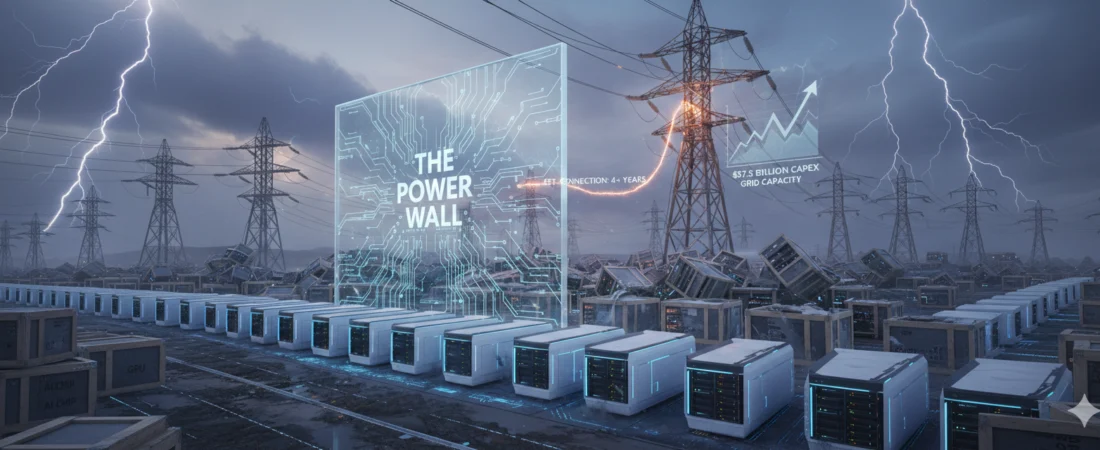
In the race for AI supremacy, the narrative has shifted. For years, the bottleneck was a shortage of silicon—the specialized GPUs needed to train and run massive models. But as we enter early 2026, a new, more rigid barrier has emerged. Despite record-breaking capital expenditure, Microsoft is facing a physical limit that money alone cannot solve: the global power grid.
1. The “Warm Shell” Crisis: Inventory Without a Home
In late 2025 and reaffirmed in January 2026, Microsoft CEO Satya Nadella made a candid admission regarding the state of their infrastructure. During an interview on the BG2 Pod, Nadella revealed that the primary bottleneck is no longer a “compute glut” but a shortage of “warm shells”—data center buildings already equipped with the necessary power and cooling infrastructure.
The reality is striking: Microsoft currently holds a massive inventory of AI chips (including Nvidia’s Blackwell series) that are sitting in warehouses. They cannot be deployed because the facilities required to house them lack active power feeds. Nadella noted: “You may actually have a bunch of chips sitting in inventory that I can’t plug in. In fact, that is my problem today.”
2. Gridlock: The 4-Year Connection Timeline
The “Power Wall” is a result of aging electrical grids that were never designed for the exponential energy demands of generative AI.
- The Interconnection Queue: In major data center hubs like Northern Virginia (PJM territory), the wait time to connect a new industrial-scale facility to the grid has stretched to between 5 and 8 years for some new applications.
- Supply Chain Lag: Critical electrical components, particularly high-voltage transformers, face lead times of 80 to 120 weeks. Transmission-scale units can now take up to 3 years to arrive from the date of order.
- Community Resistance: Microsoft is also navigating a “Community-First” era. In October 2025, the company canceled a planned 244-acre site in Caledonia, Wisconsin (Project Nova) following local pushback regarding water usage and noise. This led to Microsoft’s new “Community-First AI Infrastructure” initiative, launched in January 2026, where they pledge to pay for local grid upgrades themselves.
3. The R&D Pivot: Efficiency as a Solution
Because Microsoft cannot simply “build more” instantly, they have pivoted internal R&D to extract more revenue from the capacity they do have.
- Custom Silicon (Maia 200): On January 26, 2026, Microsoft officially unveiled the Maia 200 AI accelerator. Built on a 3nm process, this chip is designed specifically for power-efficient AI inference. It delivers 30% better performance-per-dollar than previous hardware, allowing Microsoft to run more AI tasks using the same amount of electricity.
- Small Language Models (SLMs): By investing in models like the Phi series, Microsoft can serve customers using a fraction of the power required by massive frontier models. This “efficiency-first” strategy ensures growth even while the physical footprint is constrained.
4. Financial Reality: Spending at Scale
Microsoft’s financial report for Q2 FY26 (released January 28, 2026) highlights the scale of this effort. The company reported a staggering $37.5 billion in capital expenditure for the single quarter—a 66% increase year-over-year. Most of this is dedicated to cloud and AI infrastructure, proving that the lack of data centers is a physical constraint, not a financial one.
Summary: Stuck in Traffic with a Ferrari
To put it simply, Microsoft has the “Ferrari” (the AI chips) and the “Gas Money” (the $37.5B quarterly budget), but they are currently stuck in a multi-year traffic jam on the “Power Grid Highway.”
References & Fact-Check Links
- Satya Nadella Interview (Power Wall & Warm Shells): TheStreet: Microsoft CEO drops blunt truth on AI – Bg2 Pod Admission
- Microsoft Q2 FY26 Earnings Report ($37.5B CapEx): Microsoft Investor Relations: FY26 Q2 Press Release (Jan 28, 2026)
- Maia 200 Chip Announcement (Jan 26, 2026): Official Microsoft Blog: Maia 200 – The AI accelerator built for inference
- Grid Delays & Interconnection Timelines (5-8 years): Introl: FERC’s Data Center Colocation Ruling & PJM Queue Guide
- Wisconsin Data Center Cancellation (Community Pushback): Tom’s Hardware: Microsoft cancels Wisconsin data center after community pushback
- Transformer Lead Times (80-120 weeks): Utility Dive: Transformer supply bottleneck threatens power system stability